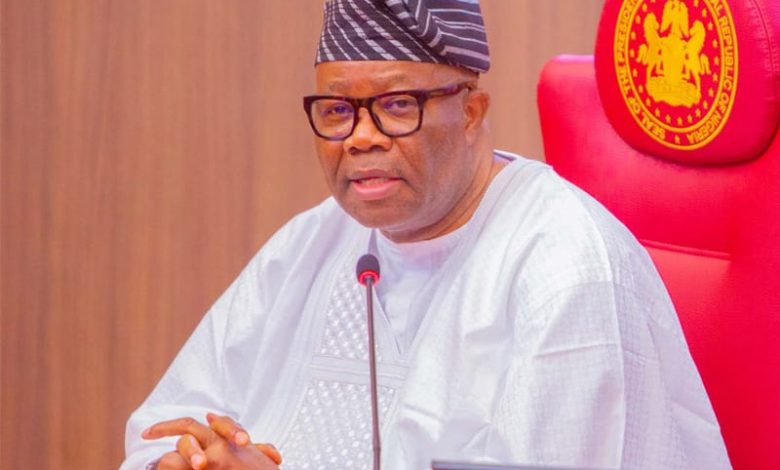
A political economist, Ayodele Peters, has accused members of the Nigerian Senate of contributing to Nigeria’s worsening political and economic challenges, alleging that personal interests and greed played a major role in the emergence of the current leadership of the National Assembly.
Our correspondent reports that Peters, spoke during a public affairs programme while reacting to the state of the nation, expressed concern over the growing insecurity, economic hardship, inflation, unemployment and declining public confidence in government institutions.

According to him, the Senate under the leadership of Senate President Godswill Akpabio has failed to provide the legislative direction and oversight required to address the country’s mounting challenges.

“The incompetence of the current Senate leadership is glaring for all Nigerians to see. At a time when citizens are battling unprecedented hardship, insecurity and economic uncertainty, the Senate has not demonstrated the courage and independence expected of a democratic institution,” Peters said.

He further claimed that the process leading to the election of Akpabio as Senate President was heavily influenced by financial inducements, resulting in what he described as weak and ineffective leadership within the National Assembly.

According to him, the intense contest between Akpabio and former Zamfara State Governor, Abdulaziz Yari, for the Senate Presidency was characterised by widespread allegations of vote-buying among senators.

“For the first time, Nigerians openly heard allegations of heavy bribery in the election of the President of the Senate. You will recall how Akpabio and Yari fiercely contested the position. A lot of money was allegedly spent to influence senators, and eventually Akpabio emerged victorious,” Peters said.
He argued that leaders who emerge through such processes often prioritise recovering political investments rather than advancing national development.
“What do you expect Akpabio to do? If someone spends heavily to secure a position, the tendency is to seek ways of recovering those resources. That is why critical projects meant for the people are not adequately funded. Public resources are diverted to political interests while ordinary Nigerians continue to suffer,” he alleged.
Peters also criticised what he described as the Senate’s inability to effectively hold the executive arm of government accountable despite worsening security challenges across different parts of the country.
“Every day, Nigerians wake up to reports of killings, kidnappings and violent attacks. Yet the National Assembly appears disconnected from the realities confronting the people. The oversight responsibility of the legislature is not being felt by citizens,” he said.
The political economist maintained that the country’s economic hardship requires a proactive and independent legislature capable of scrutinising government policies and ensuring that public resources are utilised for the benefit of the people.
“Nigerians are facing rising food prices, a weakening purchasing power and growing unemployment. These are issues that require serious legislative intervention. Unfortunately, what we are seeing is a Senate that appears more interested in political survival than national development,” he added.
Peters further expressed concern over what he described as the declining quality of legislative leadership in the country, insisting that the Senate has failed to effectively perform its constitutional responsibilities and provide the leadership needed to address Nigeria’s pressing economic and social challenges.
He called on Nigerians to demand greater transparency, accountability and integrity in the selection of leaders within the country’s democratic institutions.
“Our democracy can only thrive when competence, character and capacity become the basis for leadership selection. Until then, the country will continue to struggle with weak institutions and poor governance outcomes,” he stated.