
By Tayo Mabeweje
Journalism plays a vital role in every democracy. Its responsibility is to question power, probe policies, and give citizens the information they need to make informed judgments about those who govern them. Tough interviews are therefore an essential part of the profession. But when toughness slips into hostility and spectacle, journalism risks undermining its own purpose.

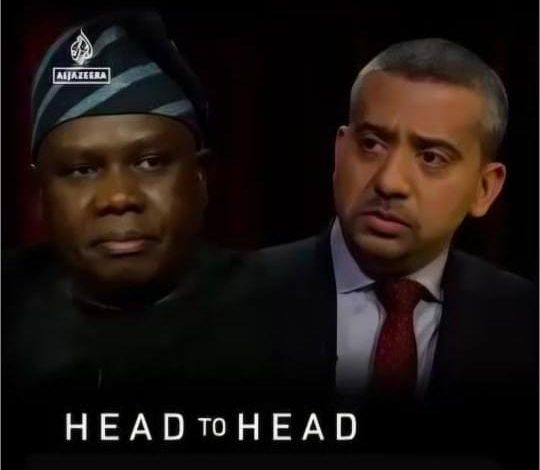
The recent exchange between Mehdi Hasan and Nigerian presidential spokesperson Daniel Bwala has once again sparked debate about where the line between accountability and ambush journalism should be drawn.
From the outset, the interview carried the tone of a confrontation rather than a conversation. Questions were delivered in rapid succession, responses were interrupted before they could fully develop, and the overall structure appeared designed to trap the guest in contradictions rather than explore issues of governance.

To be fair, the controversy surrounding the exchange does not rest entirely on the interviewer’s conduct. A significant part of the tension revolved around past statements made by Bwala while he was in opposition. When confronted with those remarks, Bwala appeared reluctant to fully acknowledge them. That hesitation may well have been at the heart of the awkwardness that followed.

However, even when a guest struggles to reconcile past statements with present responsibilities, the professional duty of the interviewer remains unchanged: maintain balance, fairness, and composure.

What many critics found troubling was the manner in which the confrontation unfolded. Presenting past statements without adequate preparation for the guest, repeatedly interrupting responses, and pressing the exchange in a way that resembled a courtroom cross-examination created the impression of an ambush. Such circumstances can easily place a guest off balance, leading to confusion or incoherent responses that do little to advance meaningful public discussion.
In that sense, the outcome of the interview may have been less a demonstration of journalistic rigor and more an example of how quickly interviews can descend into spectacle.
The broader issue raised by this episode concerns the culture of confrontational interviewing that has gained popularity in modern broadcast media. While some applaud it as fearless journalism, critics argue that it sometimes prioritizes humiliation over illumination.
In Nigeria, viewers have occasionally witnessed similar tendencies in the interviewing style of Rufai Oseni on Arise News. Oseni is widely known for his sharp and aggressive questioning of public officials. While firmness is necessary in journalism, critics have often argued that his style can cross into unnecessary hostility, with frequent interruptions and argumentative exchanges that shift attention from the subject matter to the personality of the interviewer.
This style may generate viral clips and social media attention, but it raises important questions about professionalism in journalism.
The purpose of a televised interview is not to ridicule a guest before a global audience. When that happens, the exercise risks becoming less about informing the public and more about creating moments of embarrassment for dramatic effect. Such outcomes may be entertaining for some viewers, but they ultimately weaken the credibility of the journalistic process.
There is also a practical consequence that media organizations should consider. Programs that develop reputations for publicly humiliating their guests may eventually struggle to attract credible participants. Public officials, diplomats, analysts, and experts may hesitate to appear on platforms where they believe the primary objective is confrontation rather than meaningful dialogue. In the long run, that could prove counterproductive to the sustainability and influence of such programs.
The premise that political realignment is inherently suspicious is also historically weak. Democratic politics is full of examples of leaders who criticized governments while in opposition and later worked within those same governments when political circumstances changed.
Figures such as Winston Churchill crossed party lines during their careers. In Nigeria, political figures like Bukola Saraki and Atiku Abubakar have navigated different political platforms at various stages of their political journeys.
Such developments are not unusual. Opposition exists to oppose. Political actors outside government are expected to criticize those in power. When alliances shift or circumstances change, those same actors may later collaborate with former adversaries in the interest of governance.
That is the fluid nature of democratic politics.
The responsibility of journalism is to interrogate these developments thoughtfully, not sensationally.
A strong interview should expose contradictions but still allow space for explanation. It should challenge authority without descending into ridicule. Most importantly, it should help audiences understand complex political realities rather than turning the encounter into a contest between interviewer and guest.
When journalism drifts toward spectacle and humiliation, the public conversation suffers. Accountability remains essential, but professionalism must remain the foundation upon which it stands.
Without that balance, the line between serious journalism and public performance becomes dangerously thin.