

By Seun Sobola
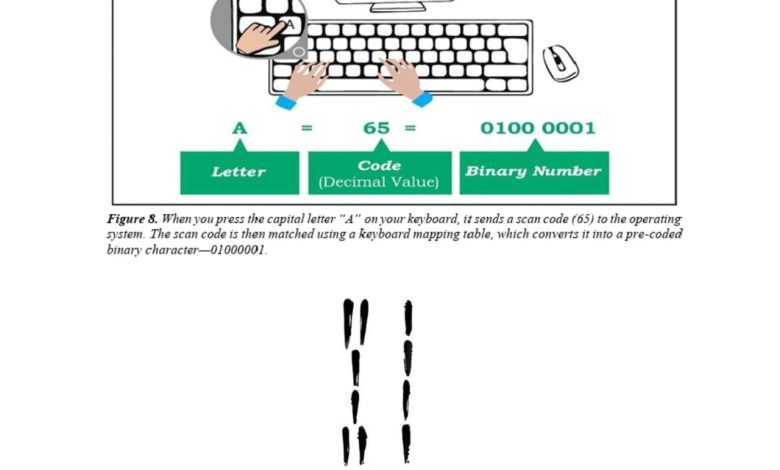
When you open your computer to send a mail across to someone, you’re basically using binary codes (0, 1, and 256) that are used to compute the operating systems of the computer. To illustrate, when you press the capital letter “A” on your keyboard, it sends a scanned code (65) to the operating system. The scanned code (65) is then matched using a keyboard mapping table, which converts it into a pre-coded binary character—01000001. But do you know that the 256 binary characters foundational to modern computer were not perfected by Silicon Valley or George Boole, but rather an ancient system of divination, Ifá 18th corpus called ogbè ìwòrì¹⁸, belonging to the Yoruba people of West Africa?

Ifá’s mathematical structure is central to understanding how deeply binary logic is rooted in Yoruba thought. Ifá’s system of divination is built on a complex structure of 0 (I) and 1(II), with 16 basic and 256 derivative figures, odù, or the body of scriptures. These figures are generated by manipulating sixteen palm nuts (ikin) or by tossing an eight-chain of half-seed shells (opele). In other words, Ifá acts in binary. Just as the 8-bit byte in Western Boolean algebra produces 256 possible values, the Yoruba system had already been encoding the same 256 binary relationships, combinatorics, and algebraic patterns that modern computers now depend on. Although George Boole is often credited with formalizing binary logic in the 19th century, Ifá had long been exploring these foundational structures.
Yet Ifá does something more. Ifá’s binary system is not a narrow mathematical tool; it bridges religion, destiny, spirituality, ethics, logic, and storytelling into a single way of understanding the world. Ifa’s complete model has no real equivalent in Western Boolean algebra, which is designed for calculation rather than meaning. For example, when you press “NUL” on the keyboard, it sends a scanned code to (0), converting it to the pre-coded binary character “00000000.” The pre-coded character “00000000” is the first sacred corpus of Ifa known as eji ogbe¹. When eji ogbe¹ is cast to an individual by the Ifa priest, such a person is told that his ori, the inner head that guides one’s destiny, is in alignment, meaning he or she chose a path of leadership, success, and longevity before coming to earth.

Historical accounts attest that Ifá’s intellectual system circulated far beyond Yoruba land. The brilliant Georgian mathematician and physicist Frank (Tony) Dodd Smith Jr. confirms that the 16 × 16 African divination patterns, the mathematical core of Ifá, circulated across different parts of the world as early as the 13th century (1). Thus, complex systems for storing and retrieving information were already embedded in African belief long before they appeared in the West. The previous statement challenges the enduring idea that computational logic is a purely Western creation.

I have experienced Ifá’s teachings personally. Didactically, it once taught me the virtue of patience: Sùúrù ni baba ìwà, patience is the father of character. It reminded me that if I work long enough, even iron may become sweet. Therefore, Ifá can function more like a doctor’s periodic checkup, guiding individuals back into harmony, alignment, and the path of their destiny.
But you might be wondering: why was Ifá’s algebraic thought not recognized on the global mathematical stage? Why was Ifá, despite its richness, left unrecognized globally? Clapperton Mavhunga et al. call the lapse an “asymmetry of definitional power… never lost to commentators in the West” (1). The authors’ arguments ring true. Our contemporary understanding of science, technology, and innovation is still shaped by countries and cultures whose global influence was built through empire, military expansion, and resource control. Sadly, systems outside that sphere, like Ifá, were rarely acknowledged as legitimate knowledge.
Western scholars have long misrepresented African traditional religion, and their writings reveal how deeply prejudice shaped their interpretations. In an attempt to erase Ifá’s intellectual and algebraic legacy, Western texts like Leo Frobenius’ The Voice of Africa (1913) and Edwin Smith’s African Ideas of God (1966) labelled the African mode of realism like Ifa as “polytheism,” “heathen,” “fetish,” “pagan,” “idolatry,” “savage,” and “juju,” and those labels have become frameworks that defined African cosmology through Eurocentric narratives. To address those racial labels, we must call for a deliberate effort to de-link, that is, to name and continually unlearn, reimagine, and reshape the structures, norms, and values that emerged from Western colonialism and continue to shape present-day knowledge, realities, and cultures. To decolonize, we must desire a shift in which individuals and institutions center alternative epistemologies that were historically marginalized.
Leo Frobenius and Edwin Smith’s labels in the preceding paragraph are rooted not in evidence, but in historical bias. African traditional religion is not primitive, and like all living religions, it has evolved over time and is grounded in deep theological reflection. Leo Frobenius and Edwin Smith’s terms are offensive and based on ignorance. African traditional religion is not “primitive,” because like every living religion, it has undergone change, maintaining elements of continuity and discontinuity; no religion exists today in its untouched, “original” form. It is equally misleading to call African deities “juju,” for the term simply means “toy,” and Africans are not so wise as to confuse sacred emblems with dolls.
Before writing this piece, I found myself asking a bold question: could the Yoruba have been the ones to teach the world binary systems and algebra? The antecedent question led me to reflect on whether Yoruba intellectualism could have influenced world mathematics. After reflecting deeply, I realized that my argument lacked strength and appeal, not because the knowledge was absent, but because we were unable to share it widely or make the global impact it deserved. Yet telling our history is important. The future of teaching our history should not be one in which we merely remember African values and knowledge should be taught, recognized, and accepted.
It is crucial that the world embrace diverse knowledge systems for a more inclusive and knowledge-based future. If we truly want diverse ways of knowing to survive and participate in modern processes, then we must begin to craft policies that allow multiple epistemologies to coexist, contribute, and shape our shared intellectual future. If the West offers a particular kind of knowledge, non-West regions can also offer knowledge systems that the world can benefit from, and one knowledge system does not diminish the other.
Works Cited
Frobenius, Leo. Voice of Africa. Benjamin Bloom, 1913.
Mavhunga, Clapperton Chakanetsa, et al. What Do Science, Technology, and Innovation Mean from Africa? The MIT Press, 2017. Project MUSE, https://muse.jhu.edu/book/60821
Smith, Edward. African Ideas of God: A Symposium. Edinburgh House Press, 1966.
Smith, Frank Dodd (Tony), Jr. From Ancient Africa. VIXRA, 2009, vixra.org/pdf/0907.0040v1.pdf. Accessed 2nd Nov. 2025.
Seun Sobola is a master’s student in English in the United States of America.